A layered object store design in Elixir (Part VI)

Summary

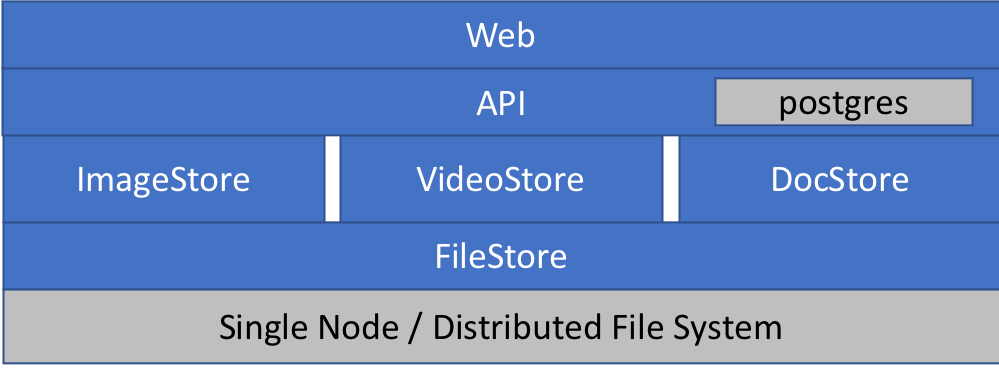
We built an object store from scratch in Elixir using a layered design approach. The overall theme has been to avoid generalizing the design too much which kept implementation of each layer/module simple. We were also careful when adding any third-party dependencies which has multiple advantages: deeper understanding of your codebase, easier debugging (I hate unknown code-paths in backtraces).

For reference, here are links for all five parts along with their summaries:

[Read More]
elixir 

A layered object store design in Elixir (Part V)

The Web layer

Part I, introduces the overall design of our object store. In this post we focus on the Web layer. This is the final layer for our object store responsible for exposing it over the web. It will expose endpoints: /upload for uploading a file and /file/:file_id for getting a file by ID. A typical GraphQL application with also expose endpoint /graphql which directly plugs into your API layer, however I will not discuss this part and stay focused on the object store side of things.

[Read More]
elixir 

A layered object store design in Elixir (Part IV)

The API layer

Part I, introduces the overall design of our object store. In this post we focus on the API layer. All layers till now were just concerned about storing the input file together with some file-format specific transforms (like thumbnails). It is at the API layer where we will be storing per-file system and user metadata. This metadata can be used to support application specific business logic and security policies.

This layer will depend on all per-file-format modules: ImageStore, VideoStore, etc. We will use Postgres for storing per-file metadata, so we also depend on the postgrex package. A typical API layer will also be exposing a GraphQL interface which forms the core of application specific business logic. I am not going to include an example GraphQL interface here but absinthe would be my preferred way of doing it, anytime.

[Read More]
elixir 

A layered object store design in Elixir (Part III)

ImageStore and VideoStore

Part I layer.

ImageStore

The ImageStore module is responsible for storing images along with their thumbnail. It will use the FileStore layer to actually store files on disk. Before we define module interfaces, lets see our application requirements:

  • All images must be stored in the jpg format.
  • Images cannot be larger than 1920x1080. We do not want to store user provided version at all.
  • Thumbnails should use the same jpg format.
  • All thumbnails must have the same size of 256x256.

Note that we are going for highly application specific requirements rather than a more general, configurable design. I have seen most of the complexity in software stacks is due to the temptation of making them “reusable”. As you will see, the implementation is going to be so simple, with clearly defined interfaces, that it would be much easier for you to create such a module for each of your applications, with its specific requirements baked in.

[Read More]
elixir 

A layered object store design in Elixir (Part II)

The FileStore layer

A layered object store design in Elixir (Part II)

Part I, introduces the overall design of our object store. In this post we focus on its first layer, the FileStore.

The FileStore layer is responsible for actually storing the file in our object store. At this level, we are not concerned about what kind of file it is (image, video, document, or whatever else), nor do we have any notion of security. We just store whatever input path is given to us.

[Read More]
elixir 

A layered object store design in Elixir (Part I)

Introduction

A layered object store design in Elixir (Part I)

I recently designed an object store from scratch in Elixir. It has been serving me well as a backend for an app which needs to store all kinds of files: images, videos, documents. I wanted something simple to avoid dealing with off-the-shelf object stores which require complex configurations and to avoid cloud storage which is dead simple to use but can get very expensive, very quickly. For this project, simplicity was the key to make sure I can debug any failures quickly.

[Read More]
elixir 

Elixir collections

Elixir is a function programming language that I have been using a lot in recent months to build all kinds of applications. Understanding of built-in collection types is essential to use any language effectively and Elixir is no different.

This posts summarizes all collection type along with pros/cons/gotchas for each one of them.

Collection Example When
Tuples {:ok, "All good"} Returning data from a function
Lists [1, "two", :three] For a collection of items
Keyword lists [one: 1, two: 2] Passing options to a function
Maps %{one: 1, two: 2} Flexible key/value store
Structs %User{name: "John", age: 32} Typed/fixed key/value store

Tuples

  • {:ok, foo} “tagged” tuple since begins with an atom like :ok or :error like {:error, 543, "some error"}

Examples:

[Read More]
elixir